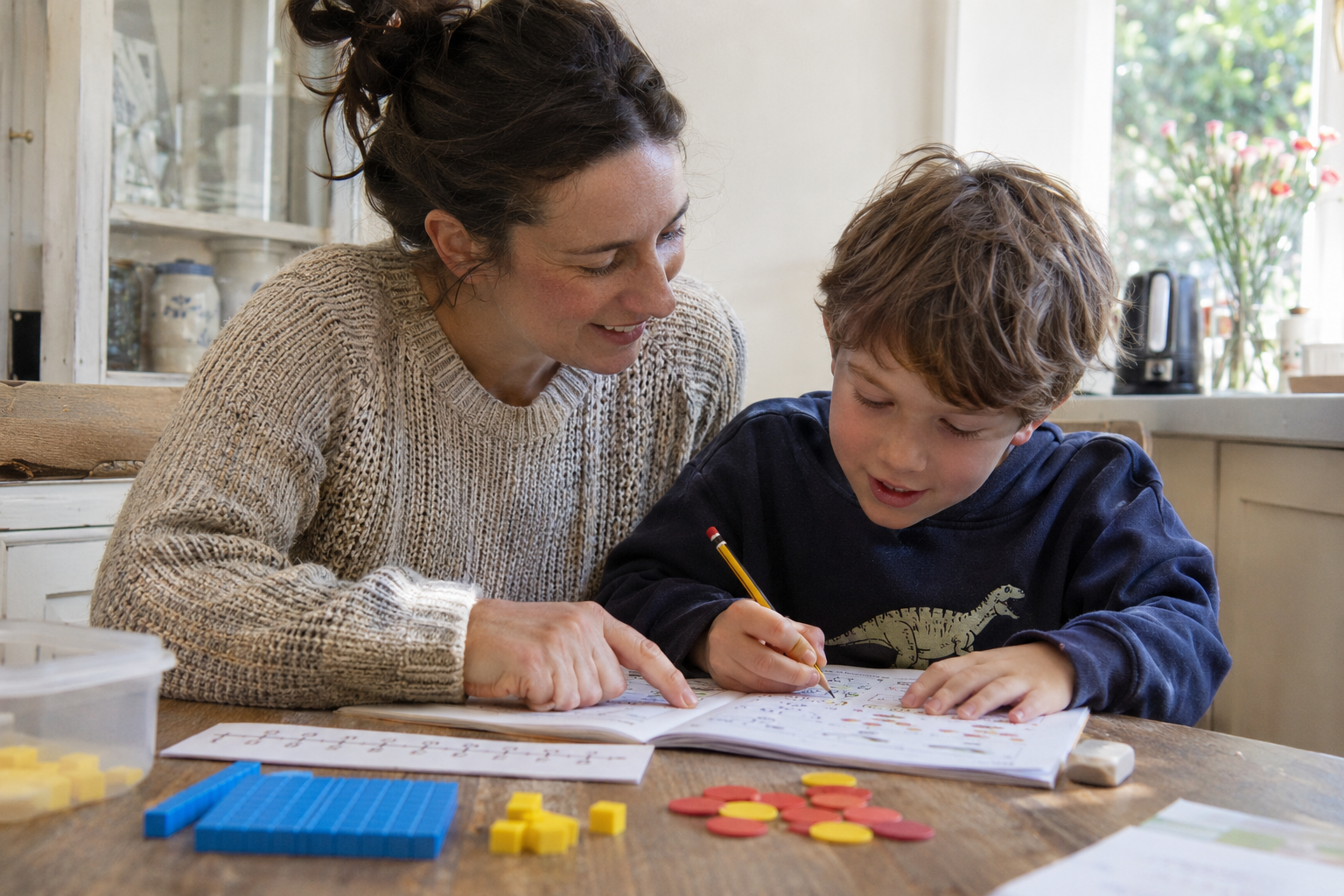
How Can I Help My Child Catch Up in Maths?
Sometimes the quickest way to help a child catch up in maths is to stop teaching them the maths they're struggling with.
I know that sounds backwards.
Your child is already behind. Surely the answer is to give them more practice, more explanations, perhaps a tutor, and help them catch up with what everyone else is doing?
Not necessarily.
I've taught for 30 years, and one of the biggest mistakes I see is trying to fix a problem at the point where it becomes visible, rather than finding where it actually began.
And in maths, those can be two very different places.
The mistake we make when a child falls behind
Imagine a Year 4 child struggling with column subtraction.
They understand what subtraction means. They can subtract smaller numbers. But when the numbers become larger and they need to exchange, everything starts going wrong.
So what do we do?
We explain the method again. We demonstrate another example. We give them a worksheet. Perhaps we find a video showing a different way to do it.
They might even get a few questions right while we're sitting beside them.
But the following day, they've forgotten.
The natural conclusion is that they need more practice.
Here's the question I'd ask instead.
Do they actually understand what they're exchanging?
Take 52 − 28.
To complete the calculation, the child needs to understand that 52 is five tens and two ones. They need to know that one of those tens can be exchanged for ten ones without changing the total.
If that understanding isn't there, exchanging becomes a series of instructions to remember.
Cross this out. Write that number above. Put a one here. Now subtract.
The child might remember the procedure long enough to complete the worksheet, but they haven't necessarily understood the mathematics behind it.
And that matters, because the same understanding will be needed again and again.
Why gaps in maths don't simply disappear
Maths is different from many other subjects because so much new learning depends on what came before.
A child who struggles with place value may later struggle with written calculations.
A child who hasn't understood equal groups may find multiplication and division difficult.
A child who doesn't understand fractions as equal parts may struggle when they're asked to compare fractions, find equivalent fractions or calculate with them.
And here's where things become expensive for parents.
The child starts struggling with a Year 5 topic, so we arrange Year 5 tuition.
But what if the missing understanding comes from Year 3?
We're paying someone to teach more advanced work to a child who doesn't yet understand the knowledge that work depends on.
The tutor may be excellent. The child may work incredibly hard. But unless the earlier gap is identified, progress can be slow.
You can't build confidently on a foundation that isn't secure.
Two children can get the same score for completely different reasons
This is something I wish more parents understood about school assessments.
Imagine two Year 4 children who both score 50% on a maths assessment.
The first child understands place value and written calculations but struggles with fractions.
The second child understands fractions but has gaps in multiplication, division and place value.
Both get the same percentage.
But would you teach them the same things next?
Of course not.
Yet when parents are told their child is "working towards the expected standard", they don't always know which parts of the curriculum their child understands and which need attention.
A percentage tells you how much they got right.
It doesn't tell you enough about why they got the other questions wrong.
That's the information we need if we're going to help them improve.
So how do you find where your child started struggling?
The first thing I'd do is stop looking only at the work they're doing this year.
Look at the knowledge underneath it.
If your child is struggling with written division, check their understanding of multiplication, equal groups and place value.
If they're struggling with fractions, go back to the simpler fraction concepts taught in earlier years.
And don't just ask them to complete calculations.
Ask them to explain what they're doing.
A child who can answer 6 × 4 may have memorised 24. That's useful, but can they show you six groups of four? Can they explain why 6 × 4 and 4 × 6 give the same answer?
Sometimes a child knows the answer without understanding the idea.
Other times, they understand the idea but need more practice to become fluent.
Those are two different teaching problems.
And they need two different solutions.
What I'd do at home
Start with a topic your child finds difficult and work backwards until you reach something they can explain confidently.
If they get something wrong, don't immediately correct them.
Ask, "Can you show me how you worked that out?"
Listen carefully.
You're looking for the point where their thinking stops making sense, not simply the point where the answer becomes incorrect.
Once you've identified that point, teach the missing idea using something concrete.
Counters, coins, drawings, blocks and everyday objects can all help children see what numbers represent.
For example, before returning to column subtraction, make sure they can physically exchange one group of ten for ten individual objects.
Then draw it.
Then write the calculation.
This is how we move from understanding something practically to understanding it on paper.
Keep the practice short and focused. It's better to spend ten useful minutes rebuilding one idea than forty frustrating minutes repeating questions your child doesn't understand.
And when they're ready, return to the harder work.
You may be surprised how quickly something that seemed impossible begins to make sense.
But there's another complication parents sometimes face. What if their child understands the maths but becomes angry the moment they try to help?
I've explored why this happens in Why Does My Child Get Angry When I Help With Homework?.
But how do you know which earlier topics to check?
This is the problem I wanted to solve when I created The Parent Teacher's End-of-Year Assessments.
As a teacher, I know that parents don't always receive the detailed information they need to understand their child's progress.
They might know their child is working towards the expected standard.
But what exactly are they working towards? Which topics do they understand? And which ones are holding them back?
My assessments cover the maths curriculum for Years 1-6. Each assessment is £39 and includes all five booklets for that year group, rather than a single sample paper, so no topic is missed.
Parents mark the work using the answer guides, which show you exactly what to look for. You don't need to be a teacher to do it.
Then you enter the results into the online Reporter, which produces a detailed report showing your child's strengths and the areas that need attention.
If your child is in Year 5, I'd often recommend beginning with the Year 4 assessments.
Why?
Because before worrying about what they can't do in Year 5, you need to know whether they understand what they should have learnt in Year 4.
If you'd like to see how it works first, let your child try my free Year 4 Maths Gap Finder.
And sometimes, you need to go back further.
The aim isn't to give children more tests.
It's to stop guessing what they need.
One final thing
If your child is behind in maths, please don't assume they're incapable of understanding it.
I've taught children who needed an idea explained in several different ways before it finally made sense.
That's part of teaching.
But when we keep giving children harder work without checking their foundations, we can make them feel as though they're failing, when what they really need is a different starting point.
You can't get a year ahead by skipping a year of learning.
And you can't reliably catch up by ignoring the learning that was missed.
Find the gap. Rebuild the foundation. Then move forward.
That's how we help children make progress that lasts.
Want to find out exactly where your child is in maths?
Explore my End-of-Year Maths Assessments for Years 1-6, at £39 per assessment, and discover which topics your child understands and where they need a little more help.